

Birth Panchang (Janma Tithi) Calculator
Every Hindu birthday has a panchang — the five limbs of the day you were born: the tithi, the nakshatra, the yoga, the karana and the weekday. This is the day your family would note for your Hindu birthday (janma tithi) and your annual rituals. Enter your birth date, time and place below to see all five — and alongside them your Lagna birth chart, the sign and house of all nine planets, and your full Vimshottari dasha timeline.
Find Your Birth Panchang
Your birth chart, planetary positions and dasha need the exact birth time and place — the ascendant changes roughly every 2 hours.
What is a birth panchang?
Panchang means “five limbs” (pancha + anga). For any moment it records five things about the Sun and Moon: the tithi (the lunar day, set by the angle between Moon and Sun), the nakshatra (the lunar mansion the Moon sits in), the yoga (a value from the combined Sun and Moon positions), the karana (half a tithi) and the vara (the weekday). Together they describe the quality of that day in the Hindu calendar.
Your birth panchang is simply this snapshot frozen at the time you were born. It is what tells you your janma tithi — the lunar date your Hindu birthday actually falls on each year, which usually differs from your English calendar date. It also gives your janma nakshatra, the birth star that drives your dasha periods and name letter.
Why your janma tithi differs from your English birthday
The English (Gregorian) calendar follows the Sun, while the Hindu calendar follows the Moon. A tithi depends on how far the Moon has pulled ahead of the Sun, and because the Moon moves quickly, the tithi of your birth returns to the sky on a different English date every year. That is why elders celebrate your birthday by tithi — say, Shukla Panchami of a particular month — rather than by the fixed English date.
Knowing your janma tithi lets you observe your birthday the traditional way, time your annual puja, and understand which fortnight (paksha) you were born in — the bright, waxing Shukla Paksha or the dark, waning Krishna Paksha.
Tithi groups: Nanda, Bhadra, Jaya, Rikta and Purna
The fifteen tithis of a paksha repeat in a fixed cycle of five qualities, so every tithi belongs to one of five groups. Nanda tithis (1, 6, 11) are tithis of joy and celebration. Bhadra tithis (2, 7, 12) are tithis of health, strength and prosperity. Jaya tithis (3, 8, 13) are tithis of victory and success. Rikta tithis (4, 9, 14) are considered empty or difficult and are usually avoided for auspicious work. Purna tithis (5, 10, 15) are tithis of fullness and completion.
Knowing which group your janma tithi falls in adds a layer of meaning to your birth panchang, and it is the same grouping that muhurat astrologers use when choosing dates for ceremonies.
Your janma nakshatra and its role in your chart
Of the five limbs, the janma nakshatra carries the most weight in a horoscope. It is the starting point of your Vimshottari dasha — the planetary timeline that maps which period of life is governed by which planet — so the birth star effectively sets the clock of your chart.
The nakshatra and its pada also fix the traditional first syllable of your name, your gana (the deva, manushya or rakshasa temperament), and the yoni and nadi used in marriage matching, along with the ruling planet that shades your Moon. This is why an astrologer asks for the birth star before almost anything else.
Your Lagna birth chart and planetary positions
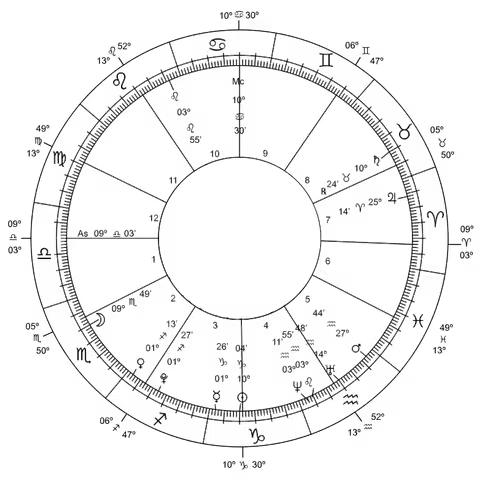
Because this calculator needs your exact birth time and place, it can do more than read the five limbs — it also casts your Lagna (ascendant) chart, the North-Indian kundli at the heart of Vedic astrology. The ascendant is the zodiac sign rising on the eastern horizon at your birth moment, and it changes roughly every two hours, which is why the time and place matter so much.
Underneath the chart you get a table of all nine grahas — the Sun, Moon, Mars, Mercury, Jupiter, Venus, Saturn and the lunar nodes Rahu and Ketu — with the sidereal sign, house and degree each one occupied, and a marker for any planet that was retrograde. Together the chart and table are the positional backbone an astrologer reads alongside your panchang.
Your Vimshottari dasha timeline
Vimshottari dasha is the most widely used planetary-period system in Vedic astrology, and it is seeded directly from your janma nakshatra. The lord of your birth star governs the first mahadasha; how far the Moon had already travelled through that star decides how much of that period was left at birth (the balance). The eight remaining planetary lords then run in a fixed order, and the nine periods together span 120 years.
The timeline below your chart lists every mahadasha with its start and end date and length in years, and highlights the period running today. It tells you which planet is currently shaping your life — the same dasha sequence an astrologer uses to time predictions.
The five limbs of your birth panchang
Your birth panchang reads five things about the sky at the moment you were born. Here is what each limb (anga) measures and why it matters.
Tithi — the lunar day
30 per lunar month
The angle between the Moon and the Sun, divided into thirty steps. Your tithi is your janma tithi — the lunar date your Hindu birthday returns to each year. Each tithi also belongs to one of five groups (Nanda, Bhadra, Jaya, Rikta, Purna) that colour its nature.
Nakshatra — the birth star
27 lunar mansions
The constellation the Moon occupied, out of twenty-seven, each split into four padas. Your janma nakshatra drives your Vimshottari dasha timeline, your traditional name syllable, and much of your Moon-based reading.
Yoga — the Sun–Moon combination
27 yogas
A value formed by adding the longitudes of the Sun and the Moon, giving one of twenty-seven named yogas. It describes the overall mood or fortune of the day you were born.
Karana — the half-tithi
Two per tithi, 11 types
Half of a tithi, so two karanas fall in every lunar day. Eleven karanas cycle through the month — four fixed and seven moving — and they fine-tune the day's suitability for action.
Vara — the weekday
7 days, 7 planet lords
The weekday, each ruled by a planet (Sunday–Sun, Monday–Moon, Tuesday–Mars, and so on). In Hindu reckoning a vara runs from one sunrise to the next, not from midnight.
Read together, these five limbs are exactly what muhurat (electional) astrology weighs to judge an auspicious moment — and they describe the moment you arrived.
How to find your birth panchang
- 1Enter your date of birth.
- 2Add your exact birth time and place — both are needed, because the ascendant chart and Vimshottari dasha depend on the precise moment and location.
- 3Press Calculate to see your tithi (and paksha), nakshatra and pada, yoga, karana and weekday.
- 4Below the panchang you also get your Lagna birth chart, a table of all nine planets with their sign, house and degree, and your full Vimshottari mahadasha timeline.
Frequently Asked Questions
- What is my janma tithi?
- Your janma tithi is the lunar date you were born on — for example, Shukla Tritiya. It is the date by which your Hindu birthday is traditionally celebrated, and it falls on a different English date each year because the Hindu calendar follows the Moon.
- Why does the calculator need my birth time and place?
- The tithi and nakshatra can change in the middle of a day, and the ascendant (Lagna) changes roughly every two hours — so the birth chart and Vimshottari dasha can only be cast from an exact moment and location. That is why this calculator asks for your birth time and place, not just the date.
- Is this the same panchang used for festivals?
- Yes — it uses the same astronomical engine and the Lahiri ayanamsa that powers our daily panchang and festival dates, just computed for your birth instant instead of today.
- What is the difference between Shukla and Krishna Paksha?
- Shukla Paksha is the bright fortnight when the Moon waxes from new to full; Krishna Paksha is the dark fortnight when it wanes from full back to new. Your tithi tells you which half you were born in.
- How is a birth panchang different from a birth chart (kundli)?
- A birth chart (kundli) maps all nine planets across the twelve houses and signs, while a panchang reads the five lunar–solar limbs — tithi, nakshatra, yoga, karana and vara — of your birth moment. They are two views of the same birth, so this calculator now shows both together: the five-limb panchang, your Lagna kundli with planetary positions, and the Vimshottari dasha that flows from your birth star.
- What is the Vimshottari dasha shown with my panchang?
- Vimshottari dasha is a 120-year sequence of planetary periods (mahadashas) calculated from the nakshatra your Moon occupied at birth. The lord of that star runs first — for the balance left in it — then the other eight planets follow in a fixed order. The timeline marks which mahadasha is running today, so you can see the planet currently governing your life.
- What do the planetary positions in the chart show?
- The table under your chart lists all nine grahas — Sun, Moon, Mars, Mercury, Jupiter, Venus, Saturn, Rahu and Ketu — with the sidereal sign and house each occupied at birth, its degree within the sign, and an (R) marker if it was retrograde. These are the sidereal (Lahiri) positions used in Vedic astrology, the same ones that place the planets in your North-Indian kundli.
- What is a karana, and why are there two each day?
- A karana is half a tithi. Because a tithi spans the Moon moving 12° ahead of the Sun, each 6° step is one karana — so two karanas complete every lunar day. There are eleven karanas in all: four fixed ones and seven that repeat through the month.
- Which weekday lord rules my birth?
- Each vara has a planetary lord: Sunday–Sun, Monday–Moon, Tuesday–Mars, Wednesday–Mercury, Thursday–Jupiter, Friday–Venus and Saturday–Saturn. Your birth panchang shows your vara, so you can see which planet governs your birth weekday.
- Is my data private — do you store my birth details or results?
- No, nothing is stored. Every calculation runs live in your browser, and we don't save the birth details you enter or your results on our servers. There's no sign-up, no account and no saved history — so you can use the calculator freely, privately and as often as you like.
References
- Surya Siddhanta tradition — the 30-tithi, 27-nakshatra, 27-yoga and karana divisions this panchang reads
- Brihat Parashara Hora Shastra — the five-limb (panchanga) framework, the Vimshottari dasha system and the whole-sign Lagna chart shown here
- Muhurta Chintamani — classical text on electional astrology and the tithi groups (Nanda, Bhadra, Jaya, Rikta, Purna)
- Lahiri (Chitrapaksha) ayanamsa — India's official sidereal standard, used in the Government of India's Rashtriya Panchang
- astronomy-engine — NASA/JPL-based planetary model that computes the Sun and Moon positions in your browser
These calculators use precise astronomical formulas with the Lahiri ayanamsa — the same standard used by traditional panchang makers. Results are for guidance and self-discovery; for major life decisions, consult a qualified astrologer.