

KP Sub-Lord Finder
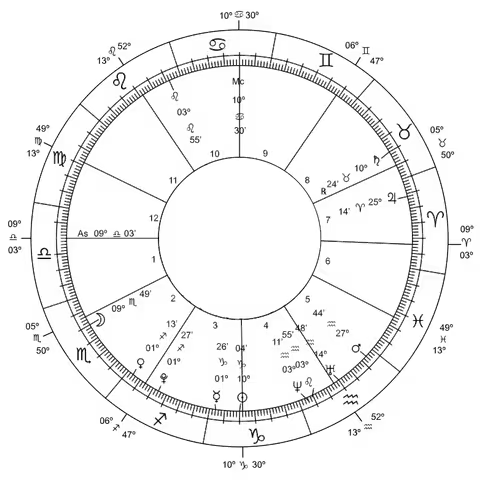
The sub-lord is the heart of KP astrology — the finest ruler of any point in your chart, and the one KP trusts to decide a result. Enter your birth details and this tool shows the full KP chain — sign, star, sub and sub-sub lord — for your ascendant and all nine planets.
KP Sub-Lord Finder
The Lagna changes roughly every 2 hours, so the exact birth time and place are needed for a correct answer.
What is a sub-lord in KP astrology?
In KP (Krishnamurti Paddhati), every degree of the zodiac is read as a chain of rulers, each finer than the last. The sign-lord sets the broad field. The star-lord — the lord of the nakshatra, or lunar mansion — colours how it unfolds. The sub-lord, the next division down, is the deciding voice: in KP it is the sub-lord that says whether a matter happens, is delayed, or is denied. A fourth level, the sub-sub-lord, refines it one step further for close work.
This is why two people with a planet in the very same sign — even the same nakshatra — can see different results. Their sub-lords differ, and in KP the sub-lord has the final say. The finder lays out all four levels for each point so you can read the chain exactly the way a KP astrologer does.
Why KP uses its own ayanamsa
KP is cast on the Krishnamurti ayanamsa, not the Lahiri ayanamsa most Vedic tools use. The two differ by only about five and a half arc-minutes, but the sub divisions are so fine that even that small shift can move a point into a different sub-lord near a boundary. That is the point of a dedicated KP setting — judging a KP chart on the wrong ayanamsa can hand you the wrong sub-lord.
So a planet's sub-lord here may not match what a Lahiri-based calculator implies, and that is expected. This tool computes every position on the Krishnamurti ayanamsa from the start, so the chain you read is the one KP itself would give.
How a sub-lord is worked out
Start with a point's longitude. The sign (30°) gives the sign-lord. The nakshatra (13°20′) gives the star-lord. Each nakshatra is then split into nine subs, sized by the Vimshottari planetary periods — Ketu 7 years, Venus 20, Sun 6, and so on to 120 — so the subs are unequal, widest for Venus and Saturn, narrowest for the Sun. The sub your point falls in gives the sub-lord. Split that sub again the same way and you get the sub-sub-lord. Because the divisions come straight from the Vimshottari proportions, the chain is exact, not looked up from a printed table.
The ascendant sub-lord — the chart's keystone
Of all the points, KP weighs the ascendant (Lagna) sub-lord most heavily — it speaks to the direction of the whole life and is the first thing a KP reading checks. That is also why this tool asks for an exact birth time and place: the ascendant moves about a degree every four minutes, so a rough time can land its sub-lord in the wrong division. Your moon and the other planets move far more slowly, so their sub-lords are steadier, but the ascendant rewards an accurate birth time.
The nine sub-lords — what each one brings
A point's sub-lord shades how its matters tend to resolve. These are the nine possible sub-lords — the same nine planets as the Vimshottari dasha — with the natural character KP reads each one by.
Jupiter
Expansive · benefic
Growth, wisdom, wealth, children and good counsel — broadly favourable, and a sub-lord that tends to support the matters of the point it rules.
Venus
Harmonious · benefic
Love, marriage, comfort, money and the arts — favourable for relationships, pleasures and partnership-related points.
Mercury
Adaptable · neutral
Communication, trade, contracts, study and negotiation — its outcome leans heavily on the planets Mercury is connected to.
Moon
Changeable · neutral
The mind, mother, public life and travel — quick to act but fluctuating, so results depend on the moment and the wider chart.
Sun
Authoritative · firm
Authority, government, the father and status — strong for official and leadership matters, but a sub-lord that tends to separate.
Mars
Driven · forceful
Energy, property, disputes, surgery and bold action — results come through effort and drive, sometimes through conflict.
Saturn
Slow · enduring
Delay, discipline, hard work, elders and the long term — slow to deliver, but able to last when the matter is pursued patiently.
Rahu
Unconventional · sudden
Sudden turns, foreign or unorthodox paths, ambition and confusion — unpredictable, often working through unexpected means.
Ketu
Detaching · spiritual
Endings, detachment, spirituality and loss — a sub-lord that tends to withdraw from or close a matter rather than build it.
These are natural leanings. A full KP judgement reads each sub-lord through the houses it signifies for your question and the ruling planets of the moment — the personalised reading available in chat.
How to use the KP sub-lord finder
- 1Enter your date of birth, exact time of birth, and birthplace.
- 2Tap Find sub-lords to cast the chart on the KP (Krishnamurti) ayanamsa.
- 3Pick any point — the ascendant or a planet — to feature its full chain.
- 4Read the chain outward: sign-lord, star-lord, sub-lord, then sub-sub-lord.
- 5For significators, ruling planets and a personalised KP reading, continue in chat.
Frequently Asked Questions
- What is a sub-lord, in simple terms?
- It is the planet ruling the small sub-division of a nakshatra that your point falls in. KP reads each point as sign-lord → star-lord → sub-lord, and the sub-lord is the one that decides the result. The sub-sub-lord is a finer division still.
- Why is my sub-lord different from my Lahiri birth chart?
- KP uses the Krishnamurti ayanamsa, which sits about five and a half arc-minutes from Lahiri. Because the subs are so fine, that small shift can move a point near a boundary into a different sub. We compute everything on the KP ayanamsa so the chain is the one KP itself would read.
- Which sub-lord matters most?
- The ascendant (Lagna) sub-lord carries the most weight in KP — it speaks to the whole life. After that, the sub-lord of whichever planet or house cusp relates to your question is what a KP reading examines.
- Do I need my exact birth time?
- For the ascendant, yes — it moves about a degree every four minutes, so a rough time can give the wrong sub-lord. The moon and other planets move slowly, so their sub-lords stay reliable even if the time is approximate.
- What is the sub-sub-lord?
- It is the next division below the sub-lord: each sub is split again in the same Vimshottari proportions. KP practitioners use it for close work, such as fine-tuning timing, once the sub-lord has set the broad answer.
- Is my data private — do you store my birth details or results?
- No, nothing is stored. Every calculation runs live in your browser, and we don't save the birth details you enter or your results on our servers. There's no sign-up, no account and no saved history — so you can use the calculator freely, privately and as often as you like.
References
- K. S. Krishnamurti — Krishnamurti Paddhati (Readers I–VI), which defines the sign → star → sub → sub-sub chain and the KP method of judgement
- Krishnamurti (KP) ayanamsa — the sidereal setting KP charts are cast on, distinct from the Lahiri standard
- Vimshottari dasha proportions (Brihat Parashara Hora Shastra) — the 120-year planetary periods that set the width of each sub and sub-sub division
- The 27 nakshatras of 13°20′ (Surya Siddhanta tradition) — the star-lord layer of the KP chain
- astronomy-engine — modern NASA/JPL-derived models that compute the planet and ascendant positions in your browser
This finder casts your chart on the KP (Krishnamurti) ayanamsa and reports the lordship chain for each point. It is a calculation tool, not a full KP judgement — a complete reading weighs the significators of the houses your question touches and the ruling planets of the moment. Treat the results as guidance, and for major decisions consult a qualified KP astrologer.