

Kaal Sarp Dosha Calculator
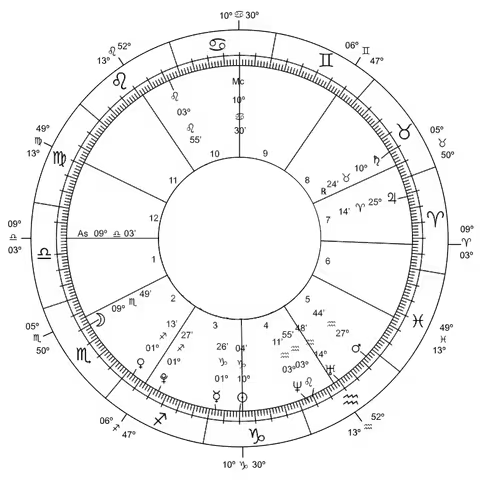
Kaal Sarp Dosha forms when all seven classical planets are hemmed on one side of the Rahu–Ketu axis — as if caught between the head and tail of the celestial serpent. This calculator checks your birth chart for the yoga, tells you whether it's full or partial, and names which of the 12 types you have, based on the house Rahu occupies.
Check Your Kaal Sarp Dosha
The Lagna changes roughly every 2 hours, so the exact birth time and place are needed for a correct answer.
What is Kaal Sarp Dosha?
Rahu and Ketu, the Moon's two nodes, always sit exactly opposite each other — an axis cutting the chart in two. Kaal Sarp Dosha is said to form when all seven other planets (Sun, Moon, Mars, Mercury, Jupiter, Venus and Saturn) fall within one half of that axis, leaving the other half empty. The image is of the planets swallowed between the serpent's mouth (Rahu) and its tail (Ketu).
If even one planet falls on the empty side, the full yoga is broken. When just one planet slips outside — or sits exactly on a node — it becomes a partial, or Aanshik, Kaal Sarp, which tradition treats as much milder.
An honest word on Kaal Sarp
Kaal Sarp Dosha is worth understanding clearly, because it is heavily over-sold. It does not appear in Brihat Parashara Hora Shastra or the other foundational classics — it is a later, Puranic-era and largely modern construct. Many ordinary charts have it; for plenty of successful people it has meant nothing at all.
We show it because people search for it and deserve an accurate check rather than a scary sales pitch. Read your result as one lens on the chart, look at where the planets actually sit, and don't let a single label overshadow everything else in your horoscope.
Full vs partial (Aanshik) Kaal Sarp
The difference matters. A full Kaal Sarp needs every one of the seven planets boxed inside the axis. If one planet has slipped just outside — often the fast-moving Moon or Mars — the yoga is only partial, and classically far weaker. A benefic like Jupiter or Venus sitting outside softens it further. This tool tells you which case you're in instead of giving a blunt yes or no.
Remedies for Kaal Sarp Dosha
Because Kaal Sarp is so over-sold, the first remedy is perspective: most charts that have it come to nothing. If it still unsettles you, the traditional responses are simple and centre on Shiva, who rules the nodes — chanting “Om Namah Shivaya”, a Rudrabhishek on Mondays, and worship on Nag Panchami. Quiet charity and service are the gentler, no-cost versions. Special Kaal Sarp pujas are offered at temples such as Trimbakeshwar, but treat them as optional reassurance, not a fee you must pay — and never let anyone frighten you into an expensive ritual.
The 12 types of Kaal Sarp Dosha
Kaal Sarp is named for the house Rahu occupies, and the type shades it toward one area of life. Rahu and Ketu always sit opposite, so each pairs two houses. The calculator names yours — here are all twelve in order.
Anant
Rahu 1st · Ketu 7th
Rahu on the ascendant turns the focus to the self and to one-to-one relationships — identity, confidence and the give-and-take of partnership. It can bring restlessness or self-doubt early on, but also a strong, self-made push once you find your feet.
Kulik
Rahu 2nd · Ketu 8th
Centres on money, family and speech against sudden change — finances and savings can swing, and words may need care. Worked through, it teaches resilience with money and a steadier tongue.
Vasuki
Rahu 3rd · Ketu 9th
Sets courage, siblings and effort against faith, fortune and long journeys — drive is strong but luck can feel inconsistent. It rewards self-effort over waiting for fate to deliver.
Shankhpal
Rahu 4th · Ketu 10th
Pulls between home and career — property, mother and peace of mind on one side, work and status on the other. Domestic calm may be hard-won while ambition keeps pushing outward.
Padma
Rahu 5th · Ketu 11th
Touches education, creativity and children, with the focus split toward gains and friendships — learning or progeny can face delays. Persistence and the right circle turn it into steady, later-arriving success.
Mahapadma
Rahu 6th · Ketu 12th
Highlights health, debts and rivals along with the hidden losses of the 12th — obstacles can seem to come from nowhere. Classically it is also a fighter's placement that overcomes enemies once the early grind is past.
Takshak
Rahu 7th · Ketu 1st
The most relationship-focused type — marriage, partnership and business ties take the spotlight, sometimes with delay or friction. Patience and the right partner make it workable rather than fated.
Karkotak
Rahu 8th · Ketu 2nd
Brings sudden change and upheaval, touching longevity, inheritance and family wealth — life can feel like ups and downs outside your control. It often forces a deeper, more resilient relationship with security.
Shankhchud
Rahu 9th · Ketu 3rd
Weighs fortune, father and beliefs against courage and self-effort — luck and faith may be tested before they settle. It tends to reward those who build their own path rather than lean on inherited support.
Ghatak
Rahu 10th · Ketu 4th
Sets career, status and authority against home and inner peace — professional drive is strong but can cost domestic calm. Balancing the two is the real work of this type.
Vishdhar
Rahu 11th · Ketu 5th
Focuses on income, gains and social circle, with attention pulled toward children and creativity — earnings can be uneven and friendships unpredictable. Steady effort turns scattered gains into real ones over time.
Sheshnag
Rahu 12th · Ketu 6th
Emphasises expenses, foreign lands and the spiritual, balanced against health and daily work — costs and worries can mount, sometimes far from home. It is also a strongly spiritual placement that grows through letting go.
The type only colours the area of focus; whether it is full or partial, and how the planets actually sit, matters far more than the name.
How to check your Kaal Sarp Dosha
- 1Enter your date of birth.
- 2Enter your exact birth time — the Kaal Sarp type depends on Rahu's house, which needs your ascendant.
- 3Select your birth place for accurate coordinates and timezone.
- 4Press Check to see whether the yoga forms, if it's full or partial, and which of the 12 types it is.
Frequently Asked Questions
- How do I know if I have Kaal Sarp Dosha?
- You have it when all seven planets — Sun through Saturn — fall between Rahu and Ketu on one side of their axis. Enter your birth details above; the calculator places every planet and tells you instantly whether the yoga forms, whether it's full or partial, and which of the 12 types applies.
- Is Kaal Sarp Dosha real or a myth?
- It is a genuine planetary pattern, but its dire reputation is modern. Kaal Sarp is not described in the classical texts like Brihat Parashara Hora Shastra — it is a later addition. Many ordinary and very successful people have it. Treat it as one factor, not a curse.
- What is partial (Aanshik) Kaal Sarp?
- When six of the seven planets are hemmed inside the Rahu–Ketu axis and just one slips outside — or a planet sits exactly on a node — the yoga is partial. It is classically considered much milder than a full Kaal Sarp, especially if the outside planet is a benefic like Jupiter or Venus.
- What are the 12 types of Kaal Sarp Dosha?
- They are named by the house Rahu occupies: Anant (1st), Kulik (2nd), Vasuki (3rd), Shankhpal (4th), Padma (5th), Mahapadma (6th), Takshak (7th), Karkotak (8th), Shankhchud (9th), Ghatak (10th), Vishdhar (11th) and Sheshnag (12th). The calculator names yours and its area of focus.
- Do I need my exact birth time?
- For the type, yes. Whether the yoga forms at all depends only on the planets' longitudes, but naming the type (Anant, Takshak…) depends on Rahu's house, which needs your exact birth time and place. Without a time we assume noon and tell you the result may shift.
- How long does Kaal Sarp Dosha last?
- There is no fixed classical duration — the “27 to 54 years” figures you see online are not from the foundational texts. Where it is felt at all, astrologers tie it to the running Rahu and Ketu periods (dashas), so its effect rises and fades with timing rather than lasting a set number of years.
- What are the remedies for Kaal Sarp Dosha?
- The traditional remedies centre on Shiva, who rules the nodes: chanting “Om Namah Shivaya”, a Monday Rudrabhishek, and worship on Nag Panchami, along with quiet charity and service. Special Kaal Sarp pujas are offered at temples like Trimbakeshwar. Because the dosha is heavily over-sold, treat any remedy as optional reassurance — never let anyone frighten you into an expensive ritual.
- Is my data private — do you store my birth details or results?
- No, nothing is stored. Every calculation runs live in your browser, and we don't save the birth details you enter or your results on our servers. There's no sign-up, no account and no saved history — so you can use the calculator freely, privately and as often as you like.
References
- Puranic node tradition — Kaal Sarp Yoga as all planets hemmed within the Rahu–Ketu axis (not found in the classical Hora texts)
- Standard Jyotish house-naming of the 12 Kaal Sarp types by Rahu's house (Anant to Sheshnag)
- Lahiri (Chitrapaksha) ayanamsa — used to place Rahu, Ketu and the seven planets
- astronomy-engine — modern NASA/JPL-derived models computing the positions in your browser
Kaal Sarp Dosha is a later, non-classical concept and its effects are widely exaggerated. This tool reports the pattern accurately for understanding, not alarm — read it alongside the whole chart and consult a qualified astrologer before acting on it.