

Cuspal Sub-Lords
The house-cusp sub-lord that decides whether a matter happens
Overview
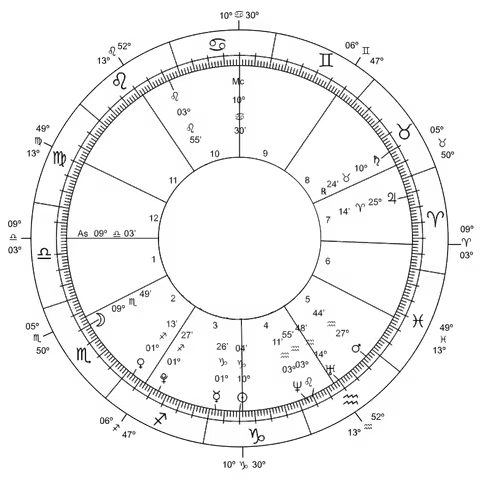
The cuspal sub-lord — often shortened to CSL — is the single most important judgment tool in KP astrology. Every house has a cusp, its exact starting degree, and that degree falls in some planet's sub; that planet is the cuspal sub-lord. In KP it has the final say over whether the matter ruled by the house will actually come to pass. Where significators tell you which planets can deliver a result, the cuspal sub-lord tells you whether the result is promised at all.
Try it yourself
KP Sub-Lord Finder
Find the sign, star, sub and sub-sub lord of your ascendant and every planet — cast on the KP (Krishnamurti) ayanamsa.
What a house cusp is in KP
In the Placidus system that KP uses, houses are unequal, so each cusp sits at a precise degree rather than at a sign boundary. That exact degree is what matters, because it decides which sub — and therefore which sub-lord — the cusp falls in. A difference of a single degree at the cusp can change the cuspal sub-lord and, with it, the whole judgement, which is why KP insists on an accurate birth time.
How the cuspal sub-lord decides a result
Once you have the cuspal sub-lord, you read the houses it signifies through its star-lord and its own placement. If those houses support the question, the matter is promised; if they include houses that work against it, the matter is denied. For marriage, for example, KP looks for the 7th cuspal sub-lord to signify the supportive houses 2, 7 and 11, and reads the houses of separation as a denial. Each kind of question has its own set of supporting and negating houses.
Working with significators and dasha
The cuspal sub-lord does not work alone — it sets the order of judgement. First the CSL tells you whether the result is promised. Then the significators of the relevant houses tell you which planets will deliver it. Finally the Vimshottari dasha and the ruling planets of the moment tell you when. Skipping the CSL step is the most common beginner mistake, because a chart can look full of promise yet be quietly denied at the cusp.
Why the CSL is KP's final word
Traditional astrology can leave a matter open, with some factors favouring an event and others against it. KP resolves that tension by giving one factor the final say. Because the cuspal sub-lord is a single planet with a clear set of signified houses, it converts a cloud of influences into a definite yes or no. This is the mechanism behind KP's reputation for clean, answerable predictions.
Sources
- Standard KP rule of judgement: the cuspal sub-lord of a bhava determines the offer of that bhava's matters (KP Readers).
Frequently asked questions
- What does CSL stand for in KP astrology?
- CSL stands for cuspal sub-lord — the planet ruling the sub in which a house cusp falls. It is KP's chief tool for deciding whether a house's matter will materialise.
- How is the cuspal sub-lord different from a significator?
- Significators are the planets that can deliver a house's results when their period runs. The cuspal sub-lord is a single planet that decides whether the result is promised at all. You check the CSL first, then the significators for timing.
- Which house cusp is most important in KP?
- The 11th cusp is checked for almost any wish, because the 11th house stands for the fulfilment of desires. The specific house for the matter — the 7th for marriage, the 10th for career — is read alongside it.
- Can a strong chart still fail because of the cuspal sub-lord?
- Yes. In KP the cuspal sub-lord has the final say. Even a chart full of favourable yogas can deny a result if the cuspal sub-lord signifies houses that negate the matter.
Get a KP reading from our AI astrologer
Have a question that needs a clear answer? Chat with our AI astrologer and explore how KP techniques apply to your chart.
Chat with AI Astrologer