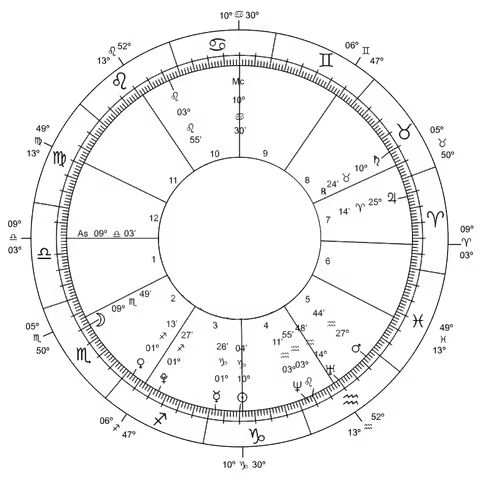
Today is Thursday, in the Krishna Paksha. Masik Shivaratri vrat is kept today. The tithi is Trayodashi till evening, then Chaturdashi begins. Trayodashi is a lively day, good for celebrations. The Moon is in Purva Ashadha nakshatra till afternoon, then Uttara Ashadha. Start new work in Abhijit Muhurta, 12:13 to 12:56, and avoid it in Rahu Kaal, 13:57 to 15:18. The Moon is in Dhanu rashi and the Sun in Makara.
Festivals on this date
Thursday, 4 February
🔱
Masik Shivaratri
Vrat
Nishita Kaal00:08 – 01:01
The puja is kept at Nishita Kaal, the middle of the night, with Chaturdashi standing.
The monthly night of Shiva, kept on each Krishna Chaturdashi while the tithi stands at midnight. Devotees fast through the day and offer water and bilva leaves to the Shivalinga in the nishita hours; the Magha one is Maha Shivratri.
✦
Purushottam Maas
·
Adhika Pausha
Sacred lunar leap month — a time for fasting, charity, and devotional practice.
Tithi · Weekday · Lunar month
TithiThe Hindu calendar's lunar day — measured by how far the moon has moved from the sun. Festivals are anchored to specific tithis (Ekadashi, Purnima…) rather than fixed Gregorian dates.Learn more in glossary
Krishna Trayodashi
Prev day13:50uptoSame day16:31
then
Krishna Chaturdashi
Same day16:31→Next day19:05
Trayodashi — a day of vitality. Good for celebration and activity.
WeekdayThe weekday, each governed by one of seven classical planets — Sunday/Sun, Monday/Moon, and so on. Each day inherits the temperament of its ruling planet.Learn more in glossary
Thursday
Thursday — ruled by Jupiter. The most auspicious weekday; favourable for learning, ceremony, and new beginnings.
Lunar monthA month in the Hindu lunar calendar. Two start conventions co-exist — Amanta begins at new moon, Purnimanta at full moon — so the same month carries two names depending on the region.Learn more in glossary
AmantaPausha
PurnimantaMagha
Nakshatra · Yoga · Karana
NakshatraThe constellation the moon is currently sitting in. The sky is divided into 27 of these; each carries its own qualities used to read birth charts and pick auspicious windows.Learn more in glossary
Purva Ashadha
Prev day12:25uptoSame day15:31
then
Uttara Ashadha
Same day15:31→Next day18:31
Fierce nakshatra — traditionally avoided for major new beginnings; better for completing or breaking patterns.
YogaA sun-moon combination that colours the day's overall character. About half the 27 yogas are considered auspicious for new starts; the rest call for restraint.Learn more in glossary
Vajra
Prev day18:43uptoSame day19:40
then
Siddhi
Same day19:40→Next day20:31
An inauspicious yoga — sun-moon energies clash today. Traditionally avoided for major new ventures.
KaranaHalf a tithi — every lunar day has two karanas in sequence. Useful when you need finer timing than a full tithi offers.Learn more in glossary
Vanij
Same day03:11uptoSame day16:31
then
Vishti
Same day16:31→Next day05:50
A movable karana — the regular daytime half-tithi. Suitable for most everyday activities.
Day at a glance
Panchang windows not defined here today
Choghadiya, Gowri and Rahu Kalam each divide local daylight into eight parts. At very high latitudes (above ~66°) the sun can stay up — or stay down — for the whole day, so a local sunrise/sunset pair doesn't exist for this date. Tithi, nakshatra and yoga above are still valid.
ChoghadiyaA North Indian timing system: eight day windows and eight night windows, each rated good, neutral, or bad. A quick way to pick (or avoid) a slot for an everyday task.Learn more in glossary
A North Indian timing system: eight day windows and eight night windows, each rated good, neutral, or bad. A quick way to pick (or avoid) a slot for an everyday task.
Gowri PanchangamA South Indian tradition that splits the day and night into eight Gowri windows each — used for picking auspicious slots for everyday work.Learn more in glossary
A South Indian tradition that splits the day and night into eight Gowri windows each — used for picking auspicious slots for everyday work.
Best & avoidA short-list of the six most important windows — three auspicious (Brahma, Abhijit, Amrit) and three to avoid (Rahu, Yamaganda, Gulika). Some days may show fewer if a window isn't computed.Learn more in glossary
A short-list of the six most important windows — three auspicious (Brahma, Abhijit, Amrit) and three to avoid (Rahu, Yamaganda, Gulika). Some days may show fewer if a window isn't computed.
HoraEach day and night splits into twelve planetary hours, each ruled by a planet. The ruling planet sets the hour's tone — pick an hour whose ruler suits the task.Learn more in glossary
Each day and night splits into twelve planetary hours, each ruled by a planet. The ruling planet sets the hour's tone — pick an hour whose ruler suits the task.
Krishna Trayodashi · Thu
Feb 4
Daily Almanac
GoodMixedAvoid
☀️
Daytime periods
8·1h 22m
ShubhAuspicious — favourable for new starts, ceremonies, and study.Learn more in glossary
07:0708:29
RogSickness — avoid important work, especially health-related matters.Learn more in glossary